
Clore Jump-N-Carry JNC660 Review: The Shop-Grade Jump Pack
Affiliate disclosure: ReviewsWhiz is reader-supported. When you buy through links on this page, we may earn a commission from Amazon at no extra cost to you. Learn more.
Before small lithium jump starters took over, the Clore Jump-N-Carry was the jump pack you saw in tow trucks and repair shops. The JNC660 is still sold today because it is tough, simple and very reliable.
In this Clore JNC660 review, we compare it to modern lithium units and explain who should still buy one.
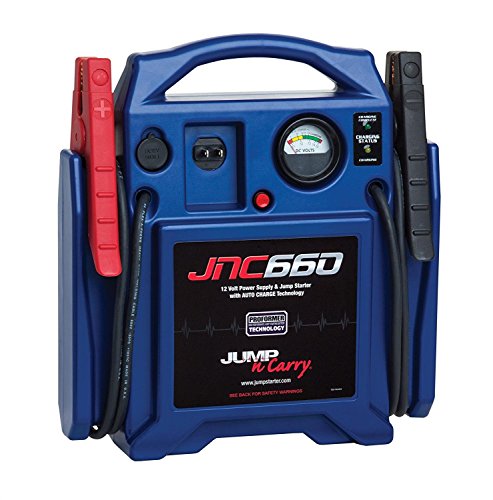
Clore Jump-N-Carry JNC660
4.4 / 5 ReviewsWhiz Score- 1700 peak amps from a 22Ah battery
- Long 46-inch heavy-duty #2 AWG cables
- Built-in voltmeter and 12V outlet
✅ Pros
- Thick #2 AWG cables deliver current well
- Long 46-inch reach
- Proven shop-grade durability
- Voltmeter shows charge level
- 12V outlet for accessories
❌ Cons
- Much heavier than lithium units
- No USB power bank
- Lead-acid battery needs regular charging
- Too big for a glove box
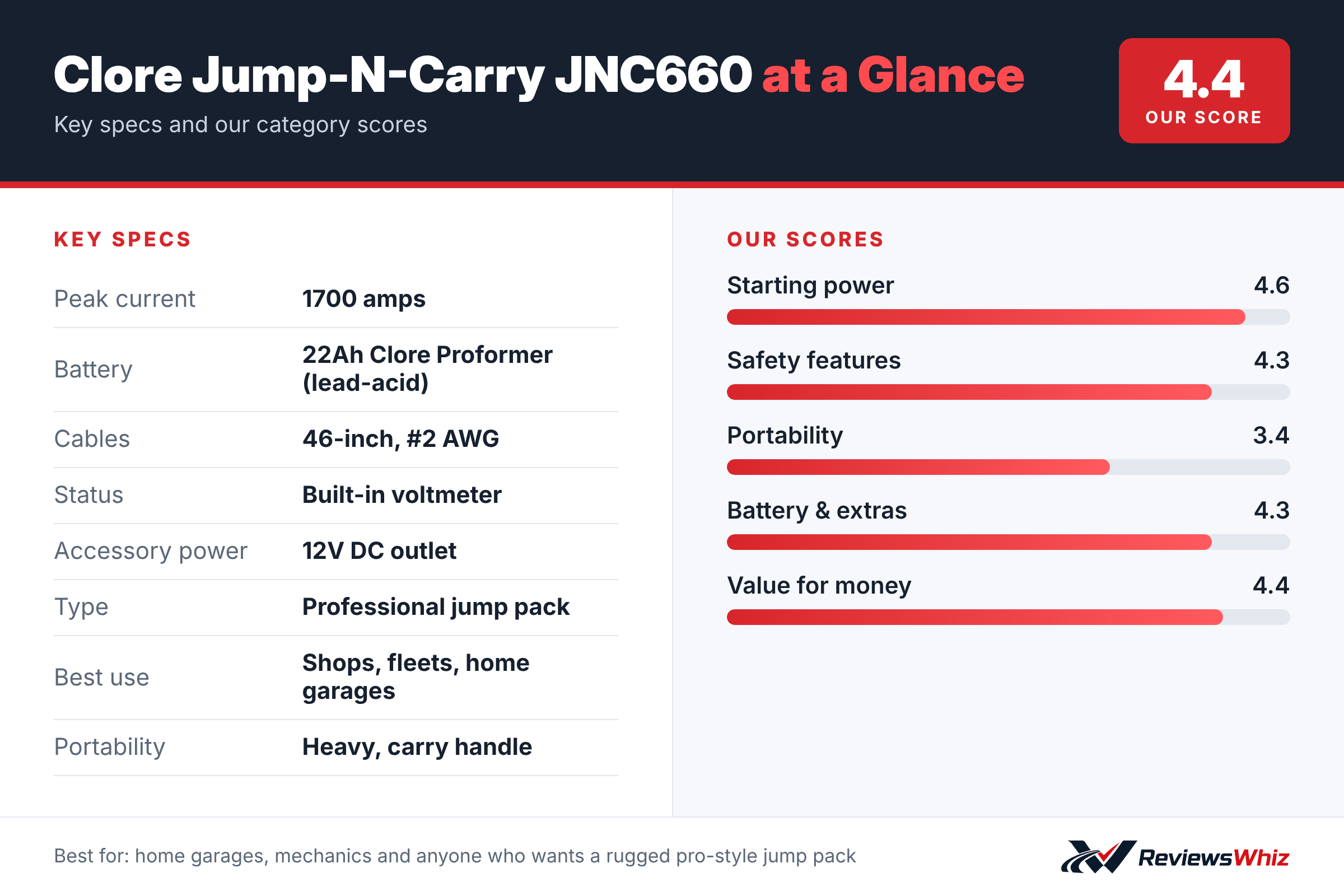
Clore Jump-N-Carry JNC660 Key Specifications
| Peak current | 1700 amps |
| Battery | 22Ah Clore Proformer (lead-acid) |
| Cables | 46-inch, #2 AWG |
| Status | Built-in voltmeter |
| Accessory power | 12V DC outlet |
| Type | Professional jump pack |
| Best use | Shops, fleets, home garages |
| Portability | Heavy, carry handle |
Power and Cables
The JNC660 uses a 22Ah Clore Proformer battery designed specifically for jump starting, with 1700 peak amps. Its 46-inch #2 AWG cables are thicker and longer than those on most consumer jump starters, which helps deliver current and reach awkward battery locations.
Simple, Useful Features
A built-in voltmeter shows the charge status of the internal battery, and a 12V DC outlet can power accessories such as a tire inflator. There are no screens or apps, which is part of its appeal.
Lead-Acid vs Lithium
The JNC660 is heavier and larger than a lithium jump starter, and it should be kept charged to protect the battery. In return, you get a design that has proven itself in professional use for years.
Who the JNC660 Is Built For
The JNC660 is a professional-style jump pack, the kind you see in repair shops, tow trucks and dealership service bays. Its long 46-inch cables and heavy #2 AWG wire reach batteries on large trucks and awkward engine bays, and the clamps grip big terminals firmly.
It is also a smart buy for home garages, farms and anyone who looks after several vehicles, boats or tractors. It is too heavy to keep in a small car’s trunk, but for a garage or work truck it is one of the most trusted tools in its class.
How to Use It Correctly
- Check the built-in voltmeter to confirm the pack is charged.
- Connect the red clamp to positive and the black clamp to the engine block or a solid ground away from the battery.
- Switch the pack on and give the car a few seconds before cranking.
- Crank in short bursts and rest between attempts.
- Switch off and disconnect after the engine starts, then recharge the pack.
Unlike many lithium units, the JNC660 does not have smart electronics that block power when clamps are reversed, so careful connection matters. Read the manual and follow the steps every time.
JNC660 vs Lithium Jump Starters
| Model | Main strength | Trade-off | Best for |
|---|---|---|---|
| Clore Jump-N-Carry JNC660 | Long heavy cables, pro durability | Heavy, needs regular charging | Shops and home garages |
| NOCO Boost GB70 | Light, smart safety, power bank | Shorter cables | Keeping in a truck or SUV |
| GOOLOO GP4000 | High power in a portable size | Less proven for daily pro use | Heavy-duty home use |
| Schumacher 1000A Lithium | Portable with USB output | Lower power | Cars and small trucks |
Keeping a Lead-Acid Jump Pack Healthy
Lead-acid batteries last longest when they are kept fully charged. Recharge the JNC660 after every use and at least once a month, even if you have not used it. Leaving it flat for weeks can permanently reduce its capacity.
Store it somewhere cool and dry, and avoid freezing temperatures when the battery is low. With good care, many owners report years of service, and the internal battery can be replaced instead of buying a new unit.
Extra Uses
The 12V outlet can power small accessories like a tire inflator, work light or phone charger in a pinch. The built-in voltmeter also lets you check the pack’s state of charge quickly. It does not have USB ports, so it is less useful as a power bank than modern lithium jump starters.
Is a Lead-Acid Jump Pack Still Worth Buying?
Lithium jump starters are lighter, smaller and easier to store, which makes them better for most drivers. But lead-acid jump packs like the JNC660 still have strengths. Their heavy cables and long reach suit professional use, they are proven in daily shop work, and their batteries can be replaced. If you need a tool that will be used several times a week in a garage, the JNC660 is still one of the best options.
Final Buying Tips
- Make sure you have space to store it upright in a garage or truck.
- Plan to charge it after every use and at least monthly.
- Check that the cables reach every battery you need to jump.
- Choose a lithium unit if you want something for your car’s trunk.
Safety Reminders
Lead-acid batteries can release hydrogen gas, especially when charging or jumping. Always work in a ventilated area, keep sparks and flames away, and wear eye protection. Connect the black clamp to a ground point away from the battery when you can. These are good habits with any jump starter, and especially with a pro pack that lacks reverse polarity lockouts.
Who Should Buy the Clore Jump-N-Carry JNC660?
Buy it if you want a durable jump pack for your garage, shop or farm and do not need it to fit in a glove box.
Skip it if you want something light to keep in your car. A NOCO GB40 or GBX45 is far smaller.
Alternatives to Consider
- NOCO Boost GB70: A lighter lithium alternative with 2000A.
- GOOLOO GP4000: Budget lithium with high peak amps.
- Schumacher 1000A Lithium: A compact consumer option.
Final Verdict
The Clore Jump-N-Carry JNC660 is old-school in the best way. It is heavy and basic, but its thick cables and rugged build make it a reliable workhorse for anyone who jump-starts cars often.
Helpful Free Car Tools
- Jump Starter Size Calculator: Peak amps needed by engine size and climate.
- Browse all free car tools and calculators
Related Reviews
Frequently Asked Questions
How many amps is the Clore JNC660?
1700 peak amps.
What battery does the JNC660 use?
A 22Ah Clore Proformer battery designed for jump starting.
How long are the cables?
46 inches, with heavy-duty #2 AWG wire.
Does the JNC660 have USB ports?
No. It has a 12V DC outlet.
Is the JNC660 good for home use?
Yes, especially in a garage, but it is heavy to carry in a car.
How we evaluated: this review is based on the manufacturer’s published specifications, the product’s feature set, and how it compares with competing products in the same price range. Product details and images are provided by Amazon and may change. Prices and availability are accurate as of the time shown on Amazon and are subject to change.